
How To Negotiate Business Partnerships
Successful business negotiations require structure, strategy, and adaptability. Instead of jumping straight to bargaining, follow this proven process that leverages the best negotiation frameworks.
Much of what follows refers to Roy Lewicki and his 4 Phases Framework.
Step 1: Preparation To Lay The Groundwork
Great negotiations start long before the first meeting. Proper preparation ensures you have the knowledge and leverage needed to drive a successful outcome.
Key Actions:
Define your objectives and non-negotiables.
Research your partner’s needs, goals, and potential constraints - over commit on this action.
Identify your BATNA (Best Alternative to a Negotiated Agreement) (Credit to Fisher & Ury) – This is your fallback plan if negotiations don’t succeed.
Establish your ZOPA (Zone of Possible Agreement) (Credit to Fisher & Ury) – The range where a mutually beneficial deal is possible.
Align internally with stakeholders to ensure clarity on deal terms and expectations.
Pro Tip: The best-prepared negotiator is often the strongest. Walk into the conversation knowing your leverage points.

Step 2: Information Exchange To Gain Clarity
This phase is about actively listening and gathering insights. The goal is to understand the other party’s interests beyond their stated positions.
Key Actions:
Open the conversation with trust-building and alignment on intent.
Ask “why” they want something, not just “what” they want (Credit to Fisher, Ury & Patton – Harvard Principled Negotiation Method).
Identify shared objectives and areas of flexibility.
Share key information that demonstrates your value proposition.
Pro Tip: Mastering active listening gives you a competitive edge. The more you understand their interests, the more creative solutions you can unlock.
Step 3: Bargaining To Explore Solutions
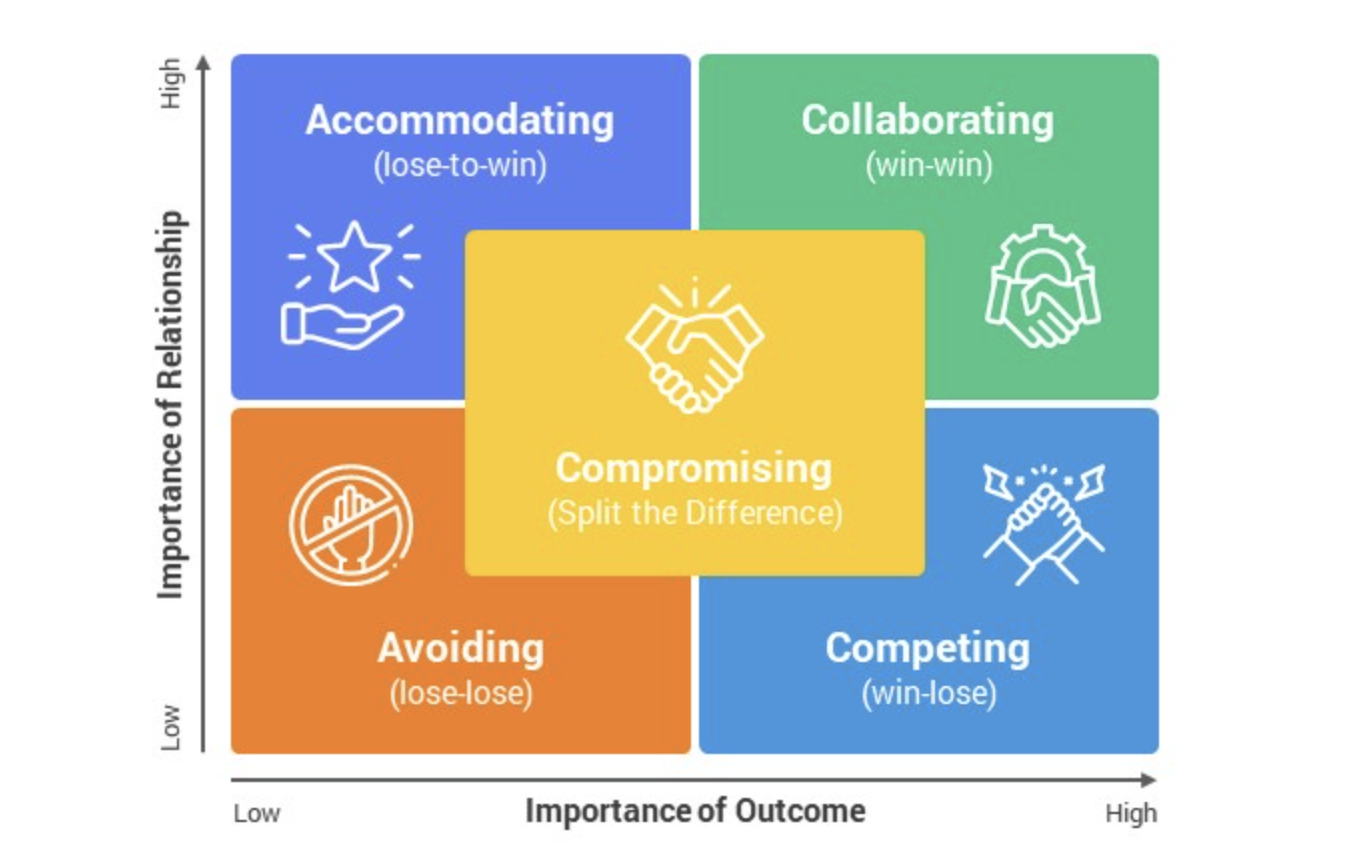
This is where negotiation strategies come into play. Use the Negotiation Matrix (Credit to Lewicki & Hiam) to adapt your approach based on context:
High Stakes? → Compete (stand firm to maximise your position).
Long-Term Partnership? → Collaborate (work together to create mutual value).
Minor Issue? → Avoid (not every issue is worth fighting for).
Relationship Matters Most? → Accommodate (prioritise goodwill over short-term wins).
Both Stakes & Relationship Matter? → Compromise (find middle ground that benefits both parties).
Key Actions:
Propose options that address both parties’ interests.
Use your BATNA as leverage to strengthen your position.
Be flexible—negotiations are about give and take.
Manage emotions and maintain professionalism.
Pro Tip: If you reach an impasse, revisit ZOPA to identify new paths forward.
Step 4: Commitment – Finalise the Agreement
Once a deal is in sight, focus on locking in terms clearly and ensuring alignment on execution.
Key Actions:
Summarise key agreements in writing before finalizing.
Clarify responsibilities, timelines, and next steps.
Confirm that both parties are fully aligned on expectations.
Establish a follow-up mechanism to monitor implementation.
Pro Tip: Deals are only as strong as their execution. A clear, documented agreement prevents misunderstandings later.
Final Thought
The best negotiators don’t win by dominating the conversation—they win by understanding.
Preparation, clarity, and adaptability create the strongest business partnerships.
The most powerful person in the room isn’t the loudest. It’s the one who is best prepared.
Need To Share This?
Text this link: https://philhsc.com/articles/how-to-negotiate-business-partnerships
Diagram References: ZOPA (strateful.com), Negotiation Matrix (slidesalad.com)
Don't know where to start with partnerships?
The Wednesday Partnership Newsletter includes 3 ideas and 1 question for you to create business partnerships that you never thought possible.
The latest issue is sent to leaders in Fortune 500 companies, entrepreneurs, educators and small business owners. Join them by entering your email and signing up for free right now.
